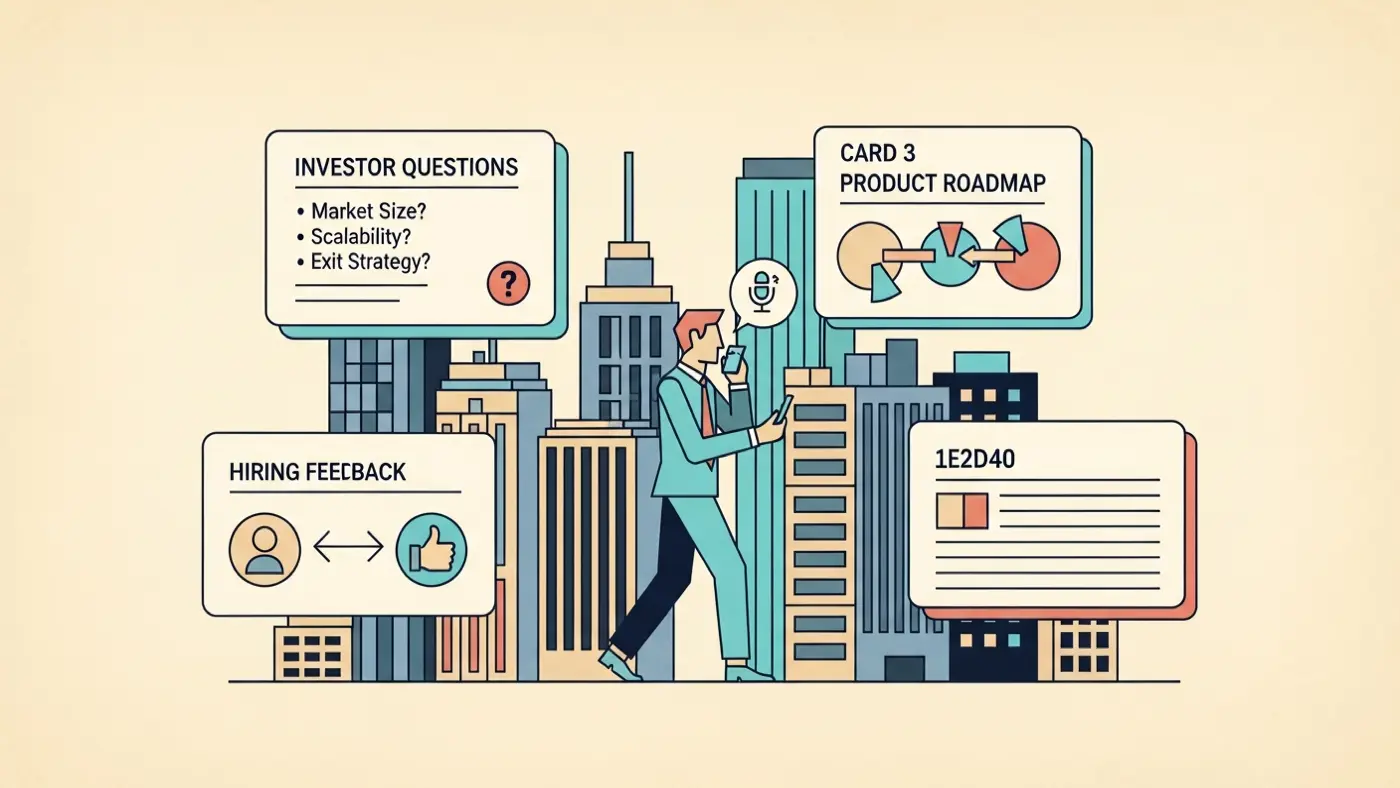
Founders are supposed to remember everything. What the investor actually said on the call, which candidate felt strong but slightly off, why the roadmap changed, who you met at the event and what they cared about. Some people manage to project that kind of recall, but most of the time it is not raw memory. It is a system.
The trouble is that the founder workday is hostile to normal note-taking. You finish a fundraising call and head straight into hiring, then leave a customer meeting to find a product fire already waiting. By the time you sit down to write the notes you were definitely going to write, the meeting has already compressed into a clean but inaccurate summary.
The details that matter are usually the ones with the shortest shelf life
You usually remember the headline: Sequoia was interested, the candidate was smart, the customer wants better onboarding. What fades first is the useful part: the partner they wanted you to meet, the hesitation before the candidate answered, the exact reason the customer did not trust the current flow. That is normal memory, not founder incompetence, and the specifics disappear faster than the gist, especially once the rest of the day starts piling on top.
For a founder, those specifics are often the whole game. A vague recollection of a VC conversation is not enough when you are trying to prepare for the next partner meeting. A fuzzy memory of an interview is not enough when you are comparing three senior candidates and the difference between them is judgment, not resume quality.
The reason voice memos show up in founder workflows
A lot of founders eventually invent the same workaround: talk into the phone right after the meeting, not because they love voice technology, but because the two-minute walk back to the office is real and the clean-up session later usually is not.
Voice fits the actual shape of the day. You can say, "Sequoia likes the market, wants to see Q2 retention, Sarah thinks Mike Zhang could be useful on the board, and I should follow up in six weeks" while the conversation is still fresh. Type that later and it turns into something shorter and flatter, a note that records what happened but loses how it felt and what seemed important in the moment.
Investor notes are mostly subtext
Fundraising conversations almost never fail or succeed on the official reason. The meeting is about numbers, but the real signal is usually hiding in tone, emphasis, and side comments: which metric they came back to twice, which risk they framed as existential versus temporary, whether the concern was market size, distribution, or just timing.
Those are the things founders regret not capturing. Not because they are impossible to remember, but because by the next day the brain starts rewriting them into a cleaner story. A quick voice memo preserves the messy version while it is still honest.
Hiring feedback has the same problem
Interview notes decay fast because the useful part is often intuitive. You are trying to hold onto a reaction: sharp on systems, weak on communication, seemed defensive on product tradeoffs, probably great in a calmer team than this one. Those are not the kinds of things most people type well at speed.
Speak them thirty seconds after the interview and you get the real version. Wait until evening and the candidate has blended with the other two people you met that day. Then you are left with resume bullets and a vague feeling you can no longer explain.
Product decisions do not just need outcomes. They need rationale.
Founders rarely forget that a decision was made. They forget why. Three months later, when someone asks why the mobile app got priority over the enterprise API or why a feature was cut before launch, the answer matters. If all you have is the decision, you end up relitigating it because the original reasoning dissolved.
This is where voice is unusually good. You can capture the texture of the tradeoff in plain speech: what the team argued, what the constraint was, who disagreed, why the risk still felt worth taking. That kind of explanation is exactly what future-you wants back.
Raw voice memos are only half the solution
The capture hack is real, but the failure mode is retrieval. A month of raw recordings turns into the same voice memo graveyard everyone eventually creates: timestamps, half-remembered contexts, too much audio to scrub through when you are under pressure.
The system starts working when the recording becomes something you can ask questions of. What did Sequoia want to see before the next meeting? What bothered me about David in the interview? Why did we decide to prioritize onboarding over expansion work? That is the difference between voice notes as a capture habit and a personal AI memory.
Founders do not need a prettier notebook. They need a memory system that works at the speed of the day they actually have. That usually means capturing by voice in the small windows between everything else, then getting it back later by asking naturally. Chronicle is built for exactly that.
Run the company with better recall
Capture the investor call, the interview reaction, and the product rationale by voice. Ask Chronicle for any of it later.