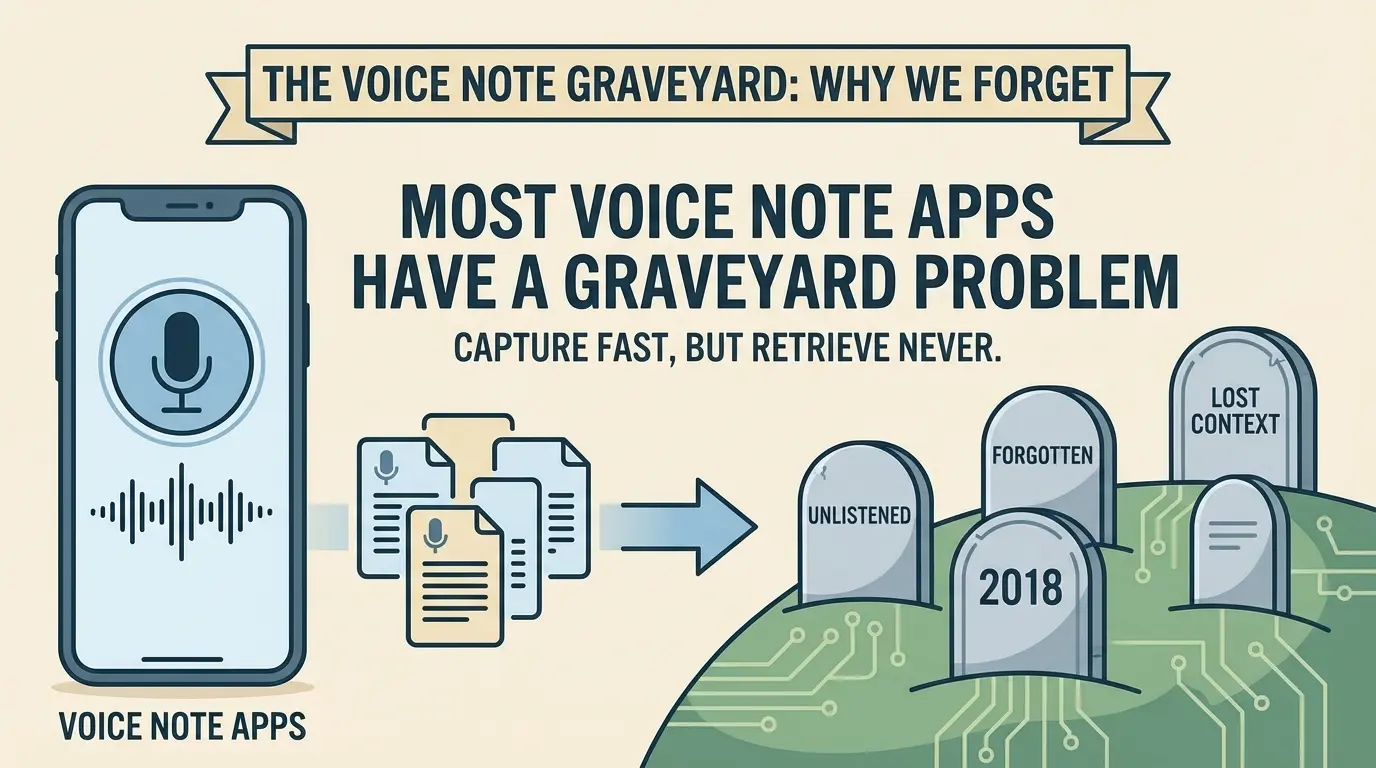
Most people who use voice notes regularly have a graveyard problem. The recordings pile up. You capture something, feel good about not losing it, and move on. Then three weeks later you need it — and you're staring at a list of untitled audio files with timestamps as names, trying to remember which one had what you're looking for.
This is the moment the habit usually breaks. Not at capture — people keep talking into their phones. It breaks at retrieval, when getting something back costs more effort than it's worth. At that point voice notes stop being a memory system and become a guilt pile: things you recorded but will never actually use.
Transcription helps. It's still not enough.
The obvious fix people reach for is transcription. If the audio becomes text, at least you can search it. That's real progress — but it solves a 2015 problem. Keyword search on transcripts still requires you to remember the exact word you used.
If you recorded a note about a meeting where a prospect raised concerns about pricing, you'd need to search "pricing" or "budget" or whatever word you actually said. If you don't remember, you're doing archaeology — trying permutation after permutation until something surfaces. That experience is familiar from early Google, from searching your own inbox, from every notes app that promised organisation and delivered a longer scroll. We've been here before.
Googling your memories is the wrong model
Search was the right tool for finding public information on the web. It works because web pages have titles, links, and structure designed to be indexed. Your thoughts don't have any of that. When you speak into your phone after a meeting, you're not writing a document — you're thinking out loud. The words you use in the moment aren't the words you'll remember later.
Asking your memories a question is a completely different interface. Not "search: Elena pricing Q3" but "What did Elena say about her budget?" Not "search: investor call concerns" but "What was I worried about after the investor meeting last week?" When you ask a question, you don't need to remember the exact words you used. You just need to remember roughly what happened.
The difference sounds subtle. In practice it's the difference between a system you use daily and one you quietly give up on.
What makes question-answering actually work
To answer a question about your memories, the system needs to understand what you meant — not just what you said. That requires something deeper than a keyword index.
The technical term is semantic understanding: the ability to grasp that "budget concerns" and "worried about cost" and "she hesitated when I mentioned the price" all point to the same underlying thing, even though they share no words. It's the difference between a filing cabinet and someone who was there and actually understood the conversation.
In plain terms: the system reads your notes the way a person would, not the way a database would. It can connect a question about a topic to a recording that never used that exact word — because meaning is what matters, not the vocabulary.
Why this matters more as the archive grows
Early on, retrieval problems are manageable. With twenty voice notes you can scroll. With fifty you can usually find things by searching. The system feels like it works.
At two hundred notes, keyword search starts failing because you've forgotten the specific words you used six months ago. At five hundred, you effectively have a write-only memory — things go in, but getting specific things back requires either luck or effort you don't have. The archive becomes a liability: technically preserved, practically inaccessible.
Semantic question-answering doesn't degrade with volume. If anything it gets more valuable the more you've captured, because the system can surface connections across recordings you'd never find by scrolling.
The gap between transcription and memory
This is the gap between a voice recorder with transcription and a personal AI memory. The first stores what you said. The second understands it well enough to answer questions about it — later, in your own words, without requiring you to remember what you called anything.
Most voice note apps have solved capture. Some have solved transcription. Very few have solved retrieval in a way that actually matches how people think. That's what Chronicle's AI voice memory app is built around: not just keeping your memories, but being able to have a conversation with them.
Ask Your Memories a Question
Chronicle understands what you meant, not just what you said. No keywords, no archaeology.