Quick answer
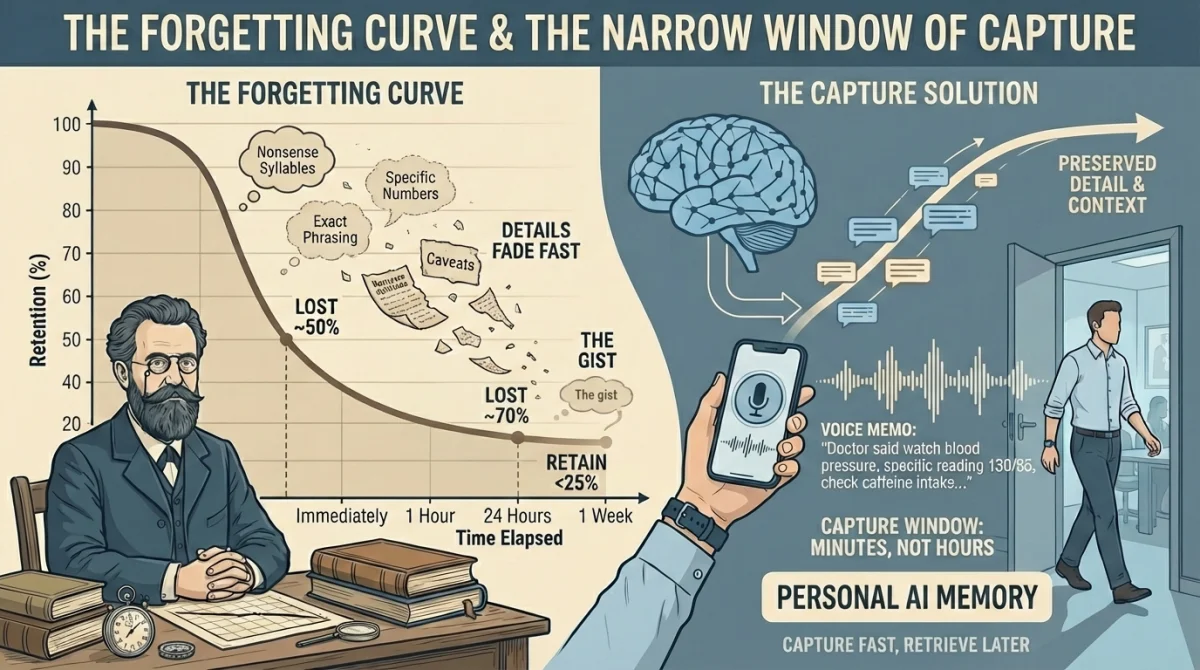
According to Ebbinghaus's forgetting curve, roughly 70% of new information can be forgotten within 24 hours of learning it. About half is already gone within the first hour, and after a week less than a quarter remains — unless the information is reviewed or recorded somewhere outside your head.
In the 1880s, a German psychologist named Hermann Ebbinghaus did something unusual: he spent years memorizing nonsense syllables and then testing himself to see how quickly he forgot them. It's a peculiar way to spend your time, but what he found became one of the most cited results in all of memory research. Within one hour of learning something new, you've forgotten about half of it. Within twenty-four hours, roughly 70% is gone. By the end of a week, you retain less than a quarter.
The curve he plotted — steep at first, then leveling off — is now known as the forgetting curve. And while later research has revised some of his numbers (his subjects were, again, meaningless syllables), the basic shape holds up across real-world information too. Meaningful content fades more slowly than nonsense, but it still fades. The lecture, the meeting, the conversation you had at dinner — the longer you wait to revisit them, the less of them remains.
The part that usually goes first
What makes the forgetting curve uncomfortable isn't just the volume of forgetting — it's what gets lost first. The gist tends to survive longer than the specifics. You remember that a conversation happened and roughly what it was about. What goes quickly are the details: the exact phrasing someone used, the number they mentioned, the caveat they attached to an otherwise clear recommendation.
Those details are often the things that actually matter. A doctor telling you to "watch your blood pressure" is memorable. The specific reading she was concerned about, the threshold she mentioned, the note about whether caffeine was a factor — those are gone within a day if you didn't write them down. You remember you were supposed to be paying attention to something. You no longer remember exactly what.
Reviewing helps, but only if you do it in time
Ebbinghaus also discovered that reviewing information before it fully decays changes the curve. Spaced repetition — revisiting something at increasing intervals — can dramatically slow forgetting. This insight spawned an entire industry of flashcard apps and learning tools that prompt you to review things just before you'd forget them.
That works well for things you want to memorize on purpose: vocabulary words, medical facts, a new programming language. It's a terrible fit for the kind of information that matters most in a working adult's life — the incidental, ambient, constantly arriving stream of things you heard, noticed, or thought of and need to be able to get back to. Nobody reviews flashcards of their conversations.
The capture window is narrower than it feels
The practical implication of the forgetting curve is that the window for preserving something at full fidelity is short — usually a few minutes to an hour. Not because you'll have completely forgotten it by then, but because that's when you still have the context that makes the detail meaningful. The dentist's caveat, the investor's exact concern, the name your friend mentioned in passing.
An hour later, you might still remember the headline. The surrounding detail that gave it weight is already thinning out. Two days later, you're reconstructing from fragments. You're not so much remembering as guessing at what probably happened based on what remains.
This is why "I'll remember it later" is almost always wrong about anything that isn't extraordinary. The forgetting curve doesn't care how important something felt in the moment.
Writing things down changes the math
Ebbinghaus found that reviewing a memory resets the curve — the forgetting starts again from a shallower slope. Something captured in writing does the same thing passively: you don't need to hold it in memory because it's already external. The cognitive load of actively trying not to forget something goes away the moment it's recorded.
The problem is that writing things down takes time and friction. Not a lot — but enough. You have thirty seconds at the end of a meeting before the next one starts. You're walking out of the doctor's office into a busy street. You have an idea in the shower. These are precisely the moments when the forgetting curve is working fastest and typing a structured note is least likely to happen.
Voice is different. You can speak at full detail in real time, in the same windows where you'd otherwise lose the information entirely. A forty-five second voice note recorded in the elevator captures more than a three-paragraph typed summary written an hour later — because the hour-later version is already a reconstruction.
Capture fast, retrieve later
The insight from the forgetting curve isn't "be more disciplined about notes." It's that the timing of capture matters more than the format. A rough voice memo taken within minutes of a conversation is worth more than a polished write-up done the next morning.
This is exactly what a personal AI memory is designed around. You speak when something happens. The transcription, the indexing, the ability to search and retrieve — all of that happens without you doing anything. Later, you ask a question in plain English and get back what you said, with context, before the curve took most of it.
Ebbinghaus spent years studying forgetting so we could understand what we were losing. Chronicle is built on the simpler proposition that the right time to preserve a memory is before the curve gets to it.
Beat the Forgetting Curve
Capture by voice the moment it happens. Ask Chronicle for it any time after.