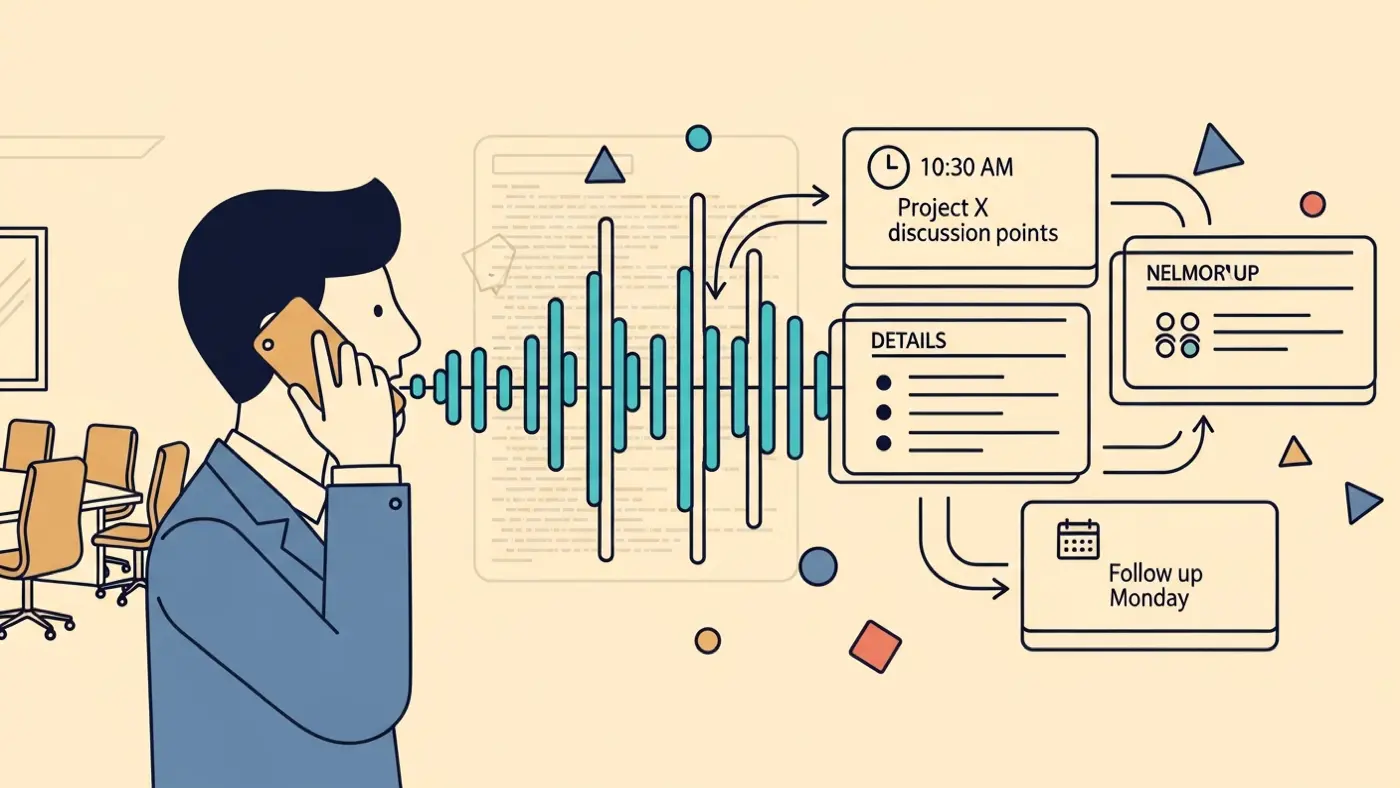
Typing feels responsible because it looks like work. Open the notes app, make a title, write something clean, tell yourself it is now handled. The problem is that most of the things worth capturing do not arrive when you are in a typing mood. They arrive while walking out of a meeting, driving home, cooking dinner, lying in bed, or standing in line with thirty seconds before your attention moves somewhere else.
That is why the real case for voice-first capture is not convenience but timing: the information you care about is usually most available at the exact moment typing is least likely to happen.
Typing asks you to switch roles
The instant you type, you stop being the person noticing something and start being the person packaging it. You decide what to call the note, how much detail to include, whether it belongs with other notes, whether this is even important enough to justify the interruption. None of that feels dramatic, but it is enough friction to kill a lot of capture.
Speaking keeps you in the original mode. You just say what happened, what stood out, what you do not want to lose, with no title, no mini taxonomic decision, and no pressure to sound organized while the memory is still forming.
Voice preserves detail before your brain rounds it off
A typed note is usually a compressed note. You write, "Dentist said crown in six months" or "investor wants better retention numbers." That sounds fine until later, when you realize the missing detail was the point. Which tooth, what threshold, which retention number, what timeline, what tone - all of that tends to vanish first.
Voice naturally carries more context. You talk in complete thoughts. You include the caveat, the example, the uncertainty, the surrounding detail that would have felt too annoying to type. That matters because the useful part of memory usually disappears first. By the time you sit down later, the brain has already started converting lived detail into a cleaner summary. The forgetting curve is already at work before you even open the app.
Speed matters, but density matters more
People often make the simple point that speech is faster than mobile typing. That is true, and it helps. But the more interesting difference is density. In thirty seconds of speech you can capture the setup, the reaction, and the follow-up. In thirty seconds of typing you usually save a stub instead.
The stub can remind you that something existed, but it often cannot give the thing back to you. Voice-first capture preserves enough of the original moment that future retrieval can work like recall instead of archaeology.
This is bigger than transcription
Raw voice memos are not the answer on their own. Everyone who records enough audio eventually builds a pile they stop revisiting. Transcription helps, but even that only solves part of the problem, because search still assumes you remember the word you used when you captured it.
What changes the experience is being able to ask a question instead of constructing a search query. That is why voice-first capture fits so naturally with personal AI memory: you speak at the moment of capture, then later retrieve in plain language. Not "budget Q3 Sarah," but "What was Sarah worried about on pricing?"If you want the longer comparison against traditional tools, the note-taking-apps piece goes deeper on that side of it.
Voice-first is not anti-writing
Writing is still the right tool for plenty of things. Plans, essays, specs, proposals, deliberate thinking. The mistake is treating writing as the right tool for the first moment of capture too, because those are different jobs.
Voice is for the live moment, when speed and fidelity matter more than polish. Writing is for the later moment, when you want to shape, argue, or present. Once you separate those two roles, a lot of frustration with note-taking disappears. You stop trying to do real-time capture with a tool that expects editorial energy.
That is the deeper case for speaking instead of typing. It is not that typing is bad, it is that most of life does not pause long enough to let typing do its best work. Chronicle is built around the simpler assumption: capture now by voice, get it back later by asking.
Capture first. Organize never.
Speak while the detail is fresh, then ask Chronicle for it later in plain English.