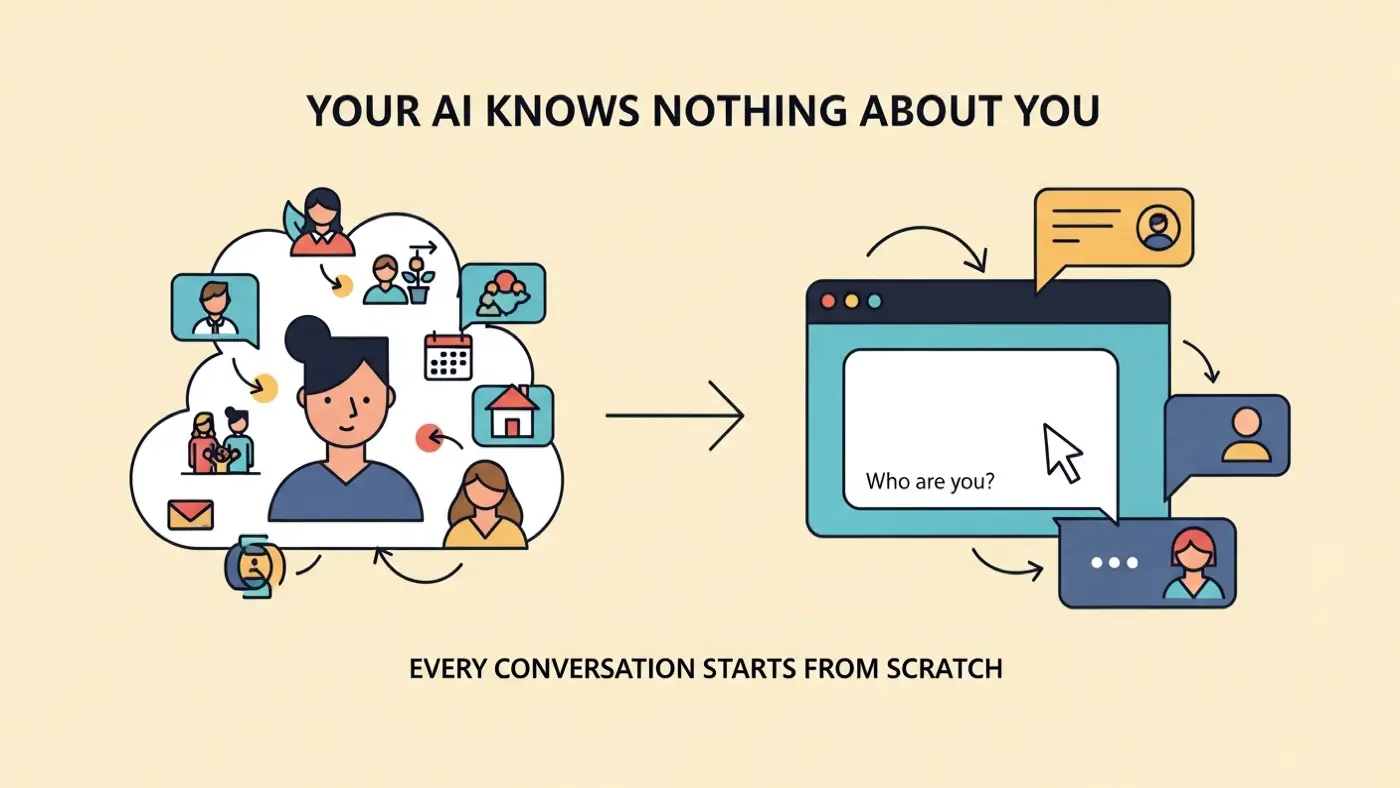
Every time you open a new conversation with ChatGPT or Claude, you are a stranger. The AI is extraordinarily capable — it can summarize research papers, debug code, draft emails in your approximate style. But it has no idea who you are. It doesn't know your name unless you tell it. It doesn't know what you do, who you work with, what you're trying to build, or what you tried last time that didn't work.
This isn't a product gap they're about to close. It's structural. Large language models don't maintain persistent memory across sessions by default. Every conversation is a blank slate. The memory features that do exist — ChatGPT's memory, Claude's Projects — store fragments selected by the AI, not you. What gets remembered is determined by algorithmic guesses about importance. Not your actual knowledge of what matters.
The new Google
In practice, most AI interaction is public knowledge querying. You ask about a historical event, a recipe, how to structure a SQL query, what a medical term means. It's Google — but you can ask in plain English and get a synthesized answer instead of ten links to sort through. That's genuinely useful. The jump from search to answer is real.
But it's still entirely operating in the public domain. Everything the AI knows about you is what you typed into that specific conversation. Everything else — your job, your relationships, your constraints, your history — is invisible to it. The model that can explain the French Revolution in five languages has no idea what you're working on right now.
Smart but amnesiac
The result is a strange kind of intelligence: powerful at every general task, blind to your specific situation. You can get good advice about negotiation tactics but not good advice about the specific negotiation you're in — the one where the other party has a particular constraint you discovered three weeks ago, where you've already tried two approaches that didn't land, where the decision-maker isn't the person in the room. That context lives in your head. The AI doesn't have access to it unless you paste it in every time.
Most people solve this by re-explaining themselves repeatedly. Every new conversation starts with the same setup: here's who I am, here's the situation, here's what I'm trying to do. It works, but the overhead accumulates. And it tends to produce generic answers, because general context produces general responses. The AI is reasoning about a category of situation, not yours.
The conversation happening in technical circles
Andrej Karpathy recently described his personal workflow for building what he calls an LLM knowledge base — an AI-maintained wiki assembled from everything he indexes: articles, papers, notes. An LLM incrementally compiles the raw material into structured articles with summaries and backlinks, viewable in Obsidian. The wiki becomes the context he feeds to his AI. His conclusion: "There is room here for an incredible new product instead of a hacky collection of scripts."
Around the same time, a founder named Farza processed 2,500 diary entries and Apple Notes through an AI that built him a personal Wikipedia — 400 articles covering people in his life, projects he's worked on, ideas he's explored, complete with backlinks. When working on a landing page, his agent pulled in philosophy notes from a documentary he'd watched, screenshots of competitor products he'd saved years ago, and design references he didn't consciously remember having. The context was there because he'd built the habit of capturing it.
Alex Kessinger has been running a version of this for a decade: 52,000 markdown files, AI-linked after every meeting. His framing is precise: the knowledge base isn't a notes archive. It's a context engineering system. Every filed artifact improves every future query. You're not organizing information for retrieval — you're building the input layer that makes your AI useful to you specifically.
What all three describe, in different ways, is the same thing: give your AI a document about you that it can actually read.
Why most people won't build this
Karpathy's workflow involves CLI tools, structured directories, and LLM scripts that run incrementally. It's a personal engineering project — real work to set up, real maintenance to sustain. He acknowledges this: he describes "agent proficiency" as a core skill of the 21st century, and that framing is honest about who he's talking to. It's not most people.
Farza's approach is more accessible but still assumes you have thousands of existing notes to process. And maintaining the input discipline — journaling, taking structured notes, saving things consistently — is exactly the behavior that breaks down under pressure. People don't fail at personal knowledge management because they lack intelligence or discipline. They fail because every capture method competes with whatever they're actually doing.
Where voice fits
Voice has a friction profile that text doesn't. You can record context about a conversation thirty seconds after it ends while walking to your next meeting. You can capture a thought in the dark before you fall asleep. You can describe a situation in the car on the way home, when the details are still fresh and you wouldn't open a notes app.
That raw, unstructured, context-rich input is the right foundation for the kind of personal knowledge base Karpathy is describing. An AI reading transcribed voice notes knows more about your actual life than most notes apps will ever accumulate — because those notes got captured in the moment when you were actually paying attention, not reconstructed later when you had time to sit down and type.
The piece that makes it a real system rather than a voice graveyard is retrieval. Asking "what do I know about this client?" should return a coherent synthesis of every note you've ever recorded that touches on them — not a list of timestamps. And asking your AI for help with something should actually use your captured context rather than prompting you to supply it again.
The explicit memory principle
Karpathy distilled four principles for personal AI memory. The one that matters most is the first: explicit. The memory should be something you can see, inspect, and understand. Not "the AI gets smarter about you over time" — that's opaque and unverifiable. An actual artifact, readable by you and by any AI you choose to use.
This is a meaningful distinction. Implicit AI memory is what most products offer — a black box that supposedly improves. Explicit memory is a knowledge base you own, that reflects what you've told it, that you can correct when it's wrong. The implicit version requires trust. The explicit version requires nothing but looking.
The AI that knows you isn't better at being an AI. It's better at being useful to you specifically — which is a different thing, and a larger gap than it sounds. Chronicle is built around exactly this: voice as the capture layer, AI as the librarian, and a personal memory you can actually ask questions of.
Give Your AI Something to Work With
Chronicle builds your personal knowledge base from voice. Ask it anything — it knows you.